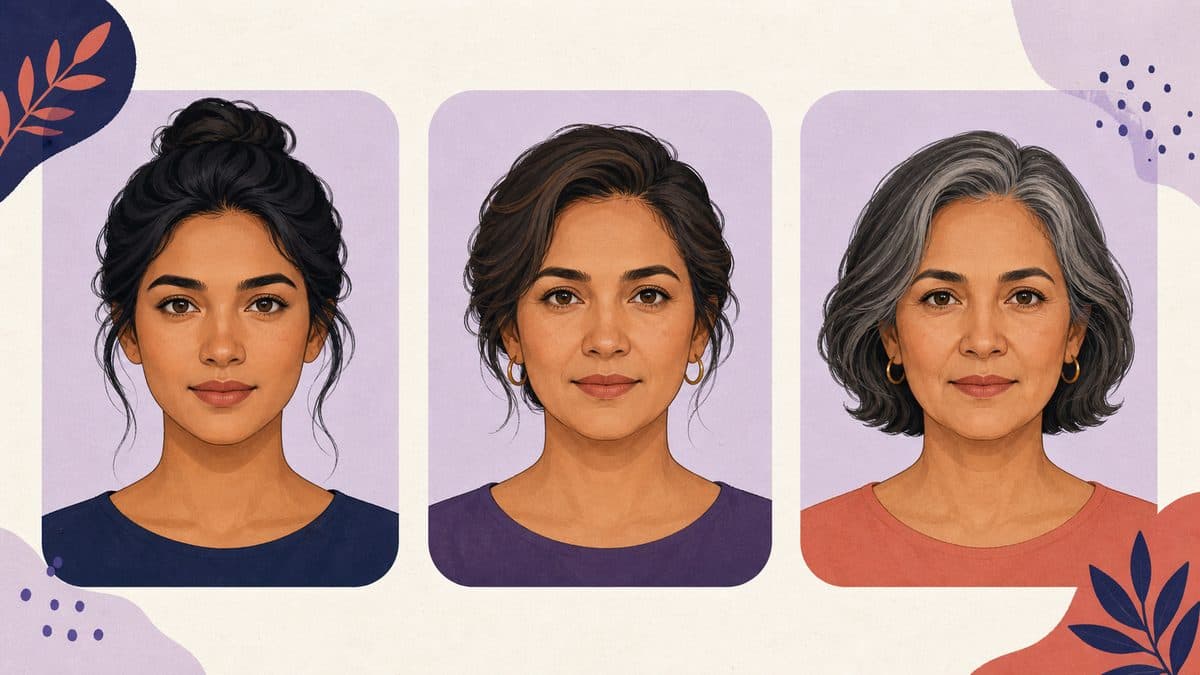
Bone structure and visible appearance are not the same thing
The bones of the face create a lasting structural framework, but a face-shape label is assigned from what is visible at the surface. Cheek fullness, the contour around the jaw, skin elasticity, hairstyle, and camera perspective all contribute to that visible outline.
This distinction explains why two accurate observations can coexist: a person's broad structural pattern may remain similar while the surface outline looks softer, narrower, fuller, or more angular at different stages of adulthood.
Natural changes in facial fullness
Facial fullness does not remain fixed. Changes can occur around the cheeks, temples, and lower face, and each area affects the outline differently. Fuller cheeks may make a face look rounder or reduce the visibility of cheekbone angles. Less cheek fullness may make the middle face and jaw transitions appear more defined.
There is no single universal sequence. Genetics, body composition, habits, and individual development vary, so the visible effect should be described rather than predicted from age alone.
Skin and soft tissue can alter the lower outline
Skin and supporting soft tissues can gradually change how sharply the jaw edge is seen. A once-clear corner may look softer, or the lower face may appear to carry width differently. That can move a visual classification near the boundary between, for example, oval and round or square and oblong.
These are general appearance observations, not medical assessments. A face-shape guide cannot diagnose a skin, dental, or health condition.
Hairstyle can create a larger visual shift than age
A fringe shortens the uninterrupted visible face, side volume adds apparent width, and height at the crown adds vertical emphasis. Hairline visibility and hair density can also change the upper outline used in a casual face-shape comparison.
Pull hair away when identifying the underlying proportions. Then use the hairstyle guide to understand how volume and framing change perception without changing structure.
Photographs from different years are difficult to compare
An old portrait and a recent phone selfie may differ in lens, camera distance, head angle, lighting, expression, focal length, and retouching. Those differences can be larger than the facial change you are trying to judge.
For a fair comparison, use similar eye-level framing, a relaxed expression, and moderate camera distance. The camera distortion article explains how close lenses alter visible proportions.
Why categories remain approximate
Oval, round, square, heart, diamond, oblong, and triangle are useful visual patterns, not fixed medical types. A person can sit between two patterns at any age. Small visible changes may change which label feels closest even when the overall structure has not transformed.
The most honest wording may be, 'My face still reads mainly oval, but the lower outline looks softer now.' The guide to mixed face-shape characteristics shows how a primary and secondary description can work together.
How to reassess your face shape
- Use a current front-facing photo instead of relying on memory.
- Keep the lens at eye level and several feet away.
- Move hair away from the temples, cheeks, and jaw.
- Compare visible face length, maximum width, cheek width, and jaw width.
- Look at jaw direction and chin shape after the main proportions.
- Use the manual identification method or analyze the photo privately.
When professional guidance may be useful
Face shape itself does not require professional evaluation. If your concern is really about a sudden or unexplained physical change, pain, swelling, skin changes, dental alignment, or another health question, a qualified healthcare or dental professional is the appropriate source of guidance. A style website and photo detector cannot assess those concerns.
For a haircut, hair condition, or frame fit, a stylist or optician can adapt general visual principles to your hair, prescription, comfort, and preferences.
A balanced conclusion
Age can change the face you see in a photograph, mainly through the visible surface and styling around a relatively stable structural framework. The change is gradual and individual. Use current proportions, accept overlap between categories, and avoid treating a face-shape label as a permanent or medical fact.
Browse the seven face-shape guides for current comparisons, then use the detector only as an informal starting point.
Frequently asked questions
Can my face shape change from round to oval with age?
The visible outline can shift enough that oval becomes a closer description, especially near a category boundary. That does not mean the underlying structure completely changed.
Does weight change face shape?
Changes in facial fullness can affect the visible outline, but the amount and location vary by person. It is better to describe current proportions than predict a category from weight.
Should I use an old photo to identify my face shape?
Use a current, well-taken photo for current styling choices. Old photos are useful for personal comparison only when pose, lens, distance, and expression are reasonably similar.
Is a sudden facial change just aging?
A style guide cannot determine that. Sudden, unexplained, painful, or concerning changes should be discussed with an appropriate qualified professional.