
Prepare the photo locally
The browser validates file type and size, reduces very large images for efficient analysis, and checks brightness and severe blur.
No account · No photo upload · Free to use
Upload a clear front-facing photo to estimate your face shape and understand the visible proportions behind the result. Your photo is processed in your browser and is not stored.
No registration, beauty score, identity check, or personal profiling.
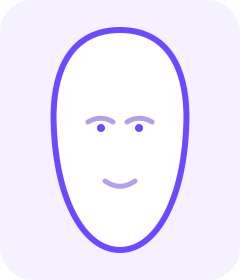
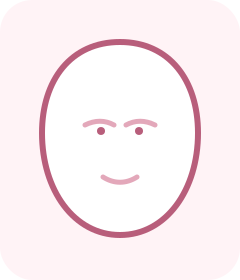
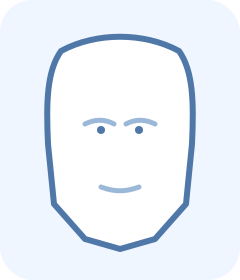
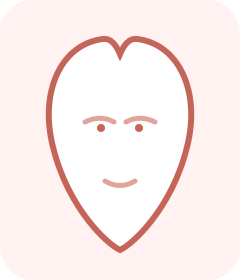
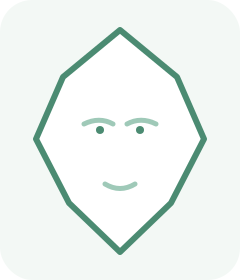
Transparent method
The tool separates landmark detection from face-shape classification, then explains the result in plain language.
The browser validates file type and size, reduces very large images for efficient analysis, and checks brightness and severe blur.
MediaPipe Face Landmarker identifies points around the face. It does not label your shape or identify who you are.
Project-owned logic compares visible length, maximum width, cheek, upper-face, jaw, chin, taper, and angle proxies.
The seven similarity scores total 100%. The leading estimate and two secondary matches show where categories overlap.
Shape library

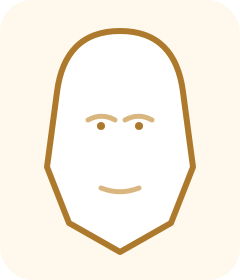
Manual method
Use one consistent photo, compare visible length and width, then examine cheekbones, jaw width, jaw corners, and chin. The guide includes a worked example and explains camera-lens distortion.
Follow the at-home stepsHair principles
Length, volume, fringe, parting, texture, density, and maintenance all matter. Learn what each choice changes without treating face shape as a beauty rule.
Explore hairstyle guidanceFrame and fit
Compare curves, angles, frame width, and lens depth only after considering bridge comfort, temples, pupillary distance, prescription, and optician advice.
Choose glasses thoughtfullyResults in context
A close phone lens can broaden central features, while camera height changes the apparent upper-to-lower taper. Head tilt, expression, uneven light, blur, hairstyle, facial hair, and a hidden jaw add more variation.
For a useful comparison, keep distance, pose, lighting, and expression consistent. If two neighbouring shapes remain close, use manual proportions to see which feature creates the overlap.
Improve photo consistencyYou might have oval-like length, diamond-like cheek emphasis, and a chin between both. Use the primary estimate as a starting point and the secondary match to refine styling choices.
How mixed face shapes workQuestions answered
Use a clear front-facing photo or compare visible face length, maximum width, cheekbone width, jaw width, jaw angle, and chin shape manually. The complete pattern matters more than one feature.
Yes. The detector and every guide are available without an account or payment.
No. Your selected photo and derived landmarks and measurements are processed in the current browser page and are not sent to our server or analytics.
Use one face, a straight head, a relaxed expression, eye-level camera placement, moderate distance, even front light, and a fully visible jaw and upper face.
Distance, lens perspective, camera height, head tilt, expression, light, hair, and visible jaw detail can change the measured landmark relationships.
Yes. Categories overlap. A primary estimate with close secondary matches often describes natural variation more honestly than one rigid label.
Yes. It compares visible proportion relationships and does not infer or require gender.
Yes. Hair can hide the cheeks, jaw, temples, or visible upper-face area. Pull it away from the outline for analysis.
No. It is an informal estimate from one photo, not a scientific, biometric, medical, or diagnostic conclusion.
Yes. The at-home guide explains a photo, mirror, and measurement method without claiming false millimetre precision.
Learning centre
Use length, cheek width, jaw taper, chin, and one simple photo test.
See how stronger length and straighter sides separate two similar outlines.
Control perspective, pose, expression, lighting, and jaw visibility.
Use secondary matches as helpful context instead of a contradiction.
Built for useful answers
We explain visible proportion patterns and their limits. The website does not infer identity, ethnicity, health, personality, emotion, gender, attractiveness, or beauty. Style suggestions remain optional and inclusive.