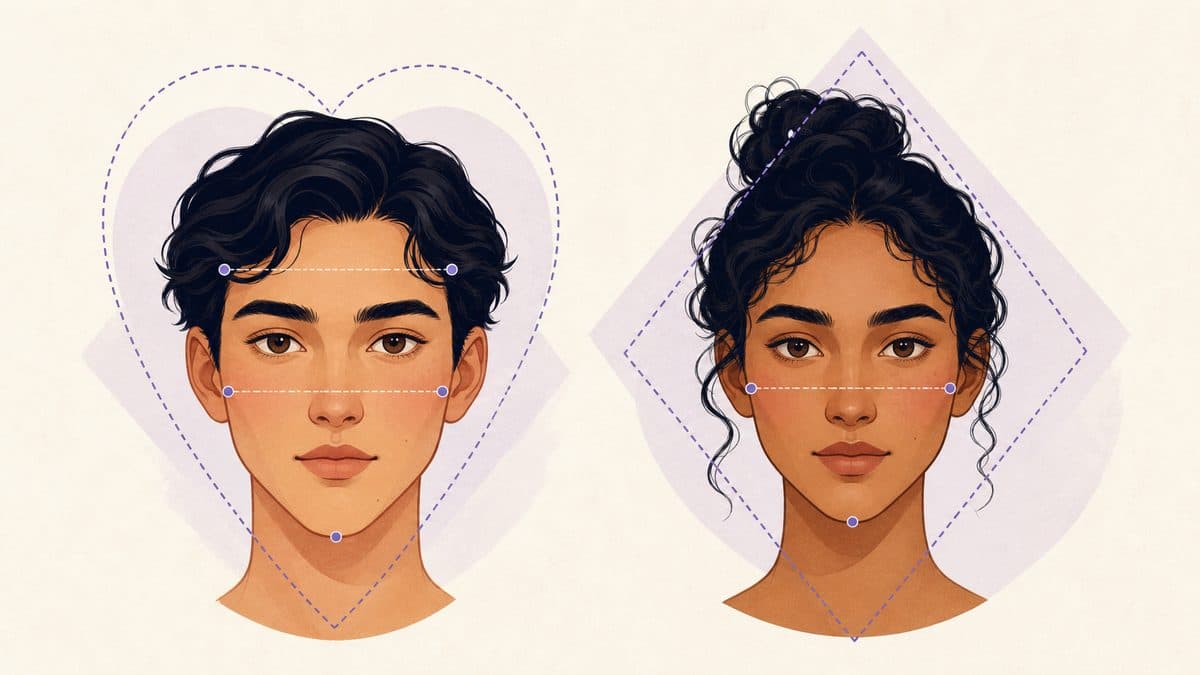
Heart and diamond at a glance
| Feature | Heart-shaped face | Diamond-shaped face |
|---|---|---|
| Widest visible area | Upper face or temples | Cheekbones |
| Upper face | Broad relative to the jaw | Narrower than the cheekbones |
| Cheekbones | Noticeable but not always the widest point | The main point of width |
| Jawline | Narrows steadily from the upper face | Narrows below prominent cheeks |
| Chin | Often narrow or pointed | Usually narrow and may look pointed |
| Overall outline | Broad-to-narrow taper | Narrow-wide-narrow rhythm |
Start with the forehead and upper face
Look at the visible width around the temples and upper sides of the face. On a heart shape, this area often sets the broadest part of the outline before the cheeks and jaw taper inward. A clearly visible hairline may add a soft heart-like curve, but hairlines vary and should never be treated as a required feature.
On a diamond face, the upper area usually looks narrower than the cheek span. Hair can hide that relationship, so pull it away gently and compare the facial outline rather than the hairstyle. The heart face guide explains upper-to-lower taper in more detail.
Check where the cheekbones sit in the outline
Diamond faces are defined by cheekbone prominence. In a straight view, the outline moves outward toward the middle of the face and then back inward toward both the temples and jaw. The widest point should look clearly centred around the cheeks, not simply full because of expression or soft tissue.
Heart faces can also have strong cheekbones. The distinction is that the upper face often matches or exceeds that width, so the cheeks do not create the same isolated middle peak. Compare the complete outline shown in the diamond face guide, not the cheek area alone.
Follow the jawline toward the chin
Both shapes tend to narrow through the lower face, which is why they are commonly confused. A heart jaw often begins its inward direction higher and creates a continuous upper-to-lower taper. A diamond jaw begins below a stronger cheekbone peak, so the change in direction can look more angular.
A pointed chin supports either category. A slightly rounded narrow chin does not rule either one out. Treat chin shape as confirmation after you locate the widest area.
A simple manual identification method
- Use a front-facing photo taken at eye level from several feet away.
- Pull hair away from the temples, cheeks, and jaw without stretching the skin.
- Compare visible upper-face width with the cheekbone span.
- Trace the direction from temples to cheeks, then from cheeks to jaw corners.
- Use the chin only as the final check.
- Repeat with a mirror or the manual face measurement guide if the widths look close.
Why the two shapes are easy to confuse
A close selfie may enlarge central features and make the cheeks look wider, nudging a heart outline toward diamond. A high camera can make the chin appear smaller and the upper face broader. Hair volume at the temples can also create heart-like width around a naturally narrower upper face.
Use the setup advice in the phone camera distortion guide before comparing small differences. One controlled photo is more useful than many selfies taken from unrelated distances.
Mixed heart-diamond characteristics
A face can have cheekbones that are slightly wider than the upper face while still showing a strong heart-like taper and pointed chin. In that case, heart-diamond is a more useful description than forcing a perfect label. Natural proportions sit on a continuum, and categories are practical summaries.
For styling, respond to the feature you can actually see. If cheek prominence is the main feature, borrow ideas from diamond guidance. If the upper face feels visually broad, heart guidance may be more relevant. The article on having more than one face shape explains how to use a secondary match.
The practical answer
Choose heart when the visible upper face is the broadest area and the outline narrows toward a small chin. Choose diamond when the cheekbones form a distinct widest point and the outline narrows both above and below them. If those widths are close, keep both descriptions and focus on the specific proportion relevant to your hairstyle or glasses.
You can analyze a clear front-facing photo privately in your browser, then compare the explanation with the full seven-shape library.
Frequently asked questions
Can a heart-shaped face have prominent cheekbones?
Yes. Prominent cheekbones do not automatically make a face diamond. Check whether the visible upper face is equally wide or wider and whether the whole outline tapers from high on the face.
Does a widow's peak mean I have a heart-shaped face?
No. A hairline shape can reinforce the visual impression, but face shape is based on the broader relationship among the upper face, cheeks, jaw, chin, and length.
Can a diamond face have a rounded chin?
Yes. The central cheekbone width and narrower upper and lower face matter more than whether the chin ends in a perfect point.
Which measurement is most useful?
Compare the visible upper-face width with the cheekbone width in the same straight photo. Then use jaw taper and chin shape as supporting evidence.