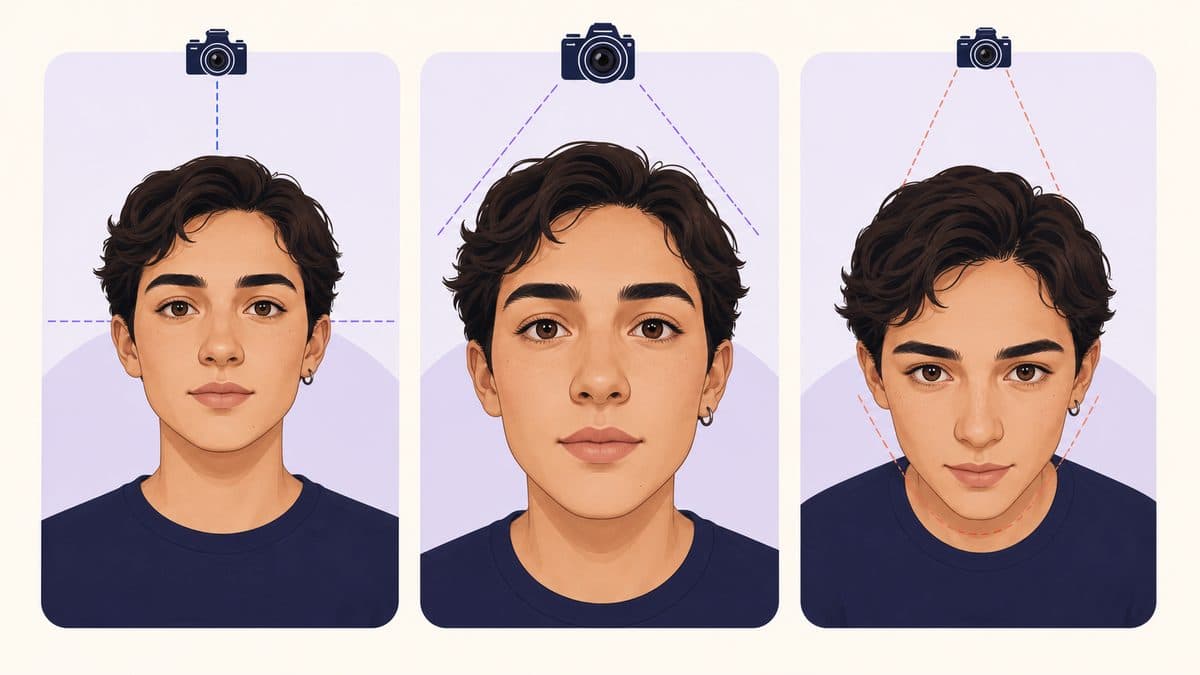
Distance changes perspective
When a phone is close, parts nearest the lens appear larger relative to the sides. Moving farther away and using modest optical zoom or cropping later usually creates a more natural-looking proportion relationship.
Camera height changes the taper
A high lens looks down toward the chin and can make the upper face appear wider. A low lens can enlarge the jaw and underside of the chin. Set the lens near eye level.
Head tilt and turn alter both sides
Tilting changes the apparent vertical axis. Turning makes the nearer cheek and jaw larger while hiding the far outline. Even a small three-quarter pose can affect cheekbone and jaw-width proxies.
Expression moves the landmarks
A wide smile raises and broadens the cheeks, changes the jaw contour, and shortens the visible area around the mouth. A clenched jaw can sharpen lower-face angles. Use a relaxed, closed-mouth expression for consistency.
Lighting and image quality affect detection
Hard side light can erase one jaw edge and exaggerate the other. Very dark images, blown highlights, motion blur, smoothing filters, and low resolution make landmark placement less stable. Soft frontal light and a clean lens help.
Hair and accessories hide the outline
Hair across the cheeks or jaw can be mistaken for the face boundary by a person and can reduce the quality of landmark context. Hats hide the upper area; sunglasses obscure eye references; masks and hands hide the lower face. Remove them for the analysis photo where practical.
A repeatable photo setup
- Clean the camera lens.
- Stand several feet away in soft front light.
- Place the camera at eye level on a stable support.
- Keep the head straight and look into the lens.
- Use a relaxed expression.
- Pull hair away from cheeks and jaw.
- Include one face and keep it large enough in frame.
- Avoid beauty filters and portrait distortions.
When manual comparison is better
Use manual measurements when repeated good photos still alternate between two neighbouring categories. Comparing the same length, cheek, upper-face, and jaw references helps you understand which feature causes the overlap.
Follow the manual identification guide, compare the result with the seven-shape library, and read the focused guide to phone camera distortion before retaking more photos. The detector remains an informal private estimate, not a guarantee.
Frequently asked questions
Which camera is best for a face-shape photo?
A normal phone or camera is sufficient when it is kept at eye level and a moderate distance. Setup consistency matters more than a particular brand.
Should I use the front or rear phone camera?
Either can work. Rear cameras often offer better quality, while the front camera makes alignment easier. Avoid holding either very close.
Can lighting change my actual face shape?
No. It changes which edges and contours are visible in the image, which can influence an estimate.