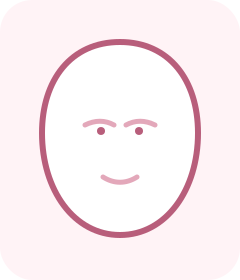
What creates the rounded outline
The cheeks contribute much of the visible width, while the jaw curves inward gently. A neutral expression is important because a broad smile can make several other shapes look rounder for a moment.
- Length and width are comparatively similar
- Cheeks appear full or prominent
- Jaw corners are subtle
- Chin follows the curve instead of projecting sharply
A simple at-home check
Stand away from the camera so the lens does not enlarge the centre of the face. Trace the visible outline mentally from temple to jaw. If the width remains curved and the length does not clearly dominate, round may be the closest label.
- Compare face length with maximum cheek width.
- Check whether the jaw has corners or a smooth arc.
- Repeat with hair pulled off the cheeks.
- Compare against oval before deciding.
Round versus oval and square
Oval faces share a soft jaw but look more elongated and taper more below the cheeks. Square faces can share a similar length-to-width relationship, yet their jaw is broader and the corners are clearer. A round face reads as curved through the whole outline.
Hair that changes the visual balance
If you want to create a longer impression, place some height above the head and avoid concentrating all volume at the widest cheek level. If you prefer to celebrate width and softness, rounded layers and cheek-level texture can do that.
- Short cuts: a little top height and controlled side volume can elongate.
- Medium and long hair: vertical lines or layers below the cheek can draw the eye downward.
- Fringes: open, side-swept, or textured fringes reveal more vertical space than a dense straight line.
- Curly and coily hair: shape volume deliberately; texture does not need to be flattened to follow the principle.
Frame choices
Angular or upswept frames can introduce contrast to a curved outline. Choose a frame wide enough that the temples remain straight, and position the eyes naturally within the lenses. Rounded frames are also valid if you prefer harmony rather than contrast.
- Check lens height against the cheeks when smiling.
- Do not choose an undersized bridge merely to make a frame look angular.
- For sunglasses, verify brow coverage and temple comfort as well as shape.
When the result is mixed
A slightly longer round outline may sit close to oval. A broader jaw may bring in square characteristics. Use secondary scores to notice those features instead of forcing a perfect category.
Common mistakes
Close selfies, a wide smile, side hair covering the jaw, and judging cheek fullness alone can all produce an incorrect round label. Base the decision on the complete outline and proportion relationships.
Frequently asked questions
Does a round face mean a person has full cheeks?
Not necessarily. Cheek appearance is one clue, but the key pattern is the relationship among length, width, and a curved jawline.
Can facial hair change the result?
Facial hair can hide the jaw and create a straighter or longer outer silhouette. Check the underlying visible jaw where possible.