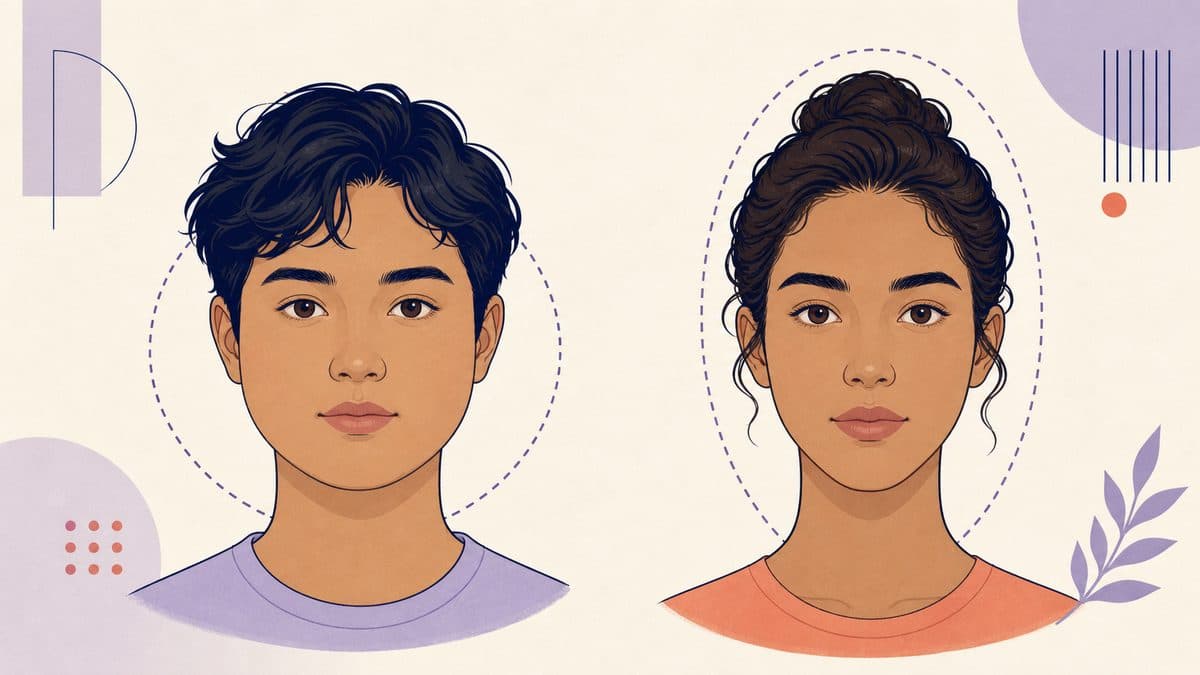
Side-by-side differences
| Feature | Round | Oval |
|---|---|---|
| Visible length | Close to maximum width | Moderately greater than width |
| Cheeks | Often create broad, curved width | Usually the widest point but less dominant |
| Jawline | Continuous soft curve | Soft curve with more taper |
| Chin | Rounded and integrated into curve | Rounded, sometimes slightly narrower |
| Overall outline | Circular impression | Elongated curved impression |
A two-minute manual test
- Use a neutral, front-facing photo from eye level.
- Mark the visible top reference and bottom of the chin to estimate length.
- Compare that distance with the widest cheek-to-cheek span.
- Trace the lower outline: look for a broad arc or a longer taper.
- Repeat from a second photo only if distance and angle match.
Why cheeks cause confusion
Both shapes can look widest around the cheekbones. Cheek fullness alone cannot decide the category. On a round face, the cheek width is a larger part of the total silhouette because length is comparatively short. On an oval face, the longer vertical axis changes the overall impression.
Camera angle can reverse the result
A close phone camera can enlarge the centre of the face and make cheeks look wider. A high camera may narrow the chin and lengthen the lower outline. A low camera can widen the jaw. Step back, keep the lens at eye level, and avoid strong head tilt.
Mixed round-oval characteristics
If the length is only slightly greater than width and the jaw tapers softly, both labels may fit. Use round styling ideas when thinking about cheek width and oval ideas when thinking about the jaw. A secondary match does not invalidate the primary estimate.
The practical conclusion
Choose oval when the face is clearly elongated with a gradual lower taper. Choose round when width and length are closer and the entire outline reads as a soft curve. Keep both when the difference is small.
Compare the full round face guide and oval face guide, then use the manual measurement method or analyze a clear photo privately to check the same features.
Frequently asked questions
Can a round face have a narrow chin?
It can have some taper, but a clearly narrow or pointed chin may bring oval or heart characteristics into the comparison.
Does smiling make an oval face look round?
Yes. Smiling can broaden the cheeks and shorten the visible lower face. Use a relaxed expression for comparison.
Which measurement matters most?
Start with visible length compared with maximum width, then use jaw taper and chin shape to confirm.