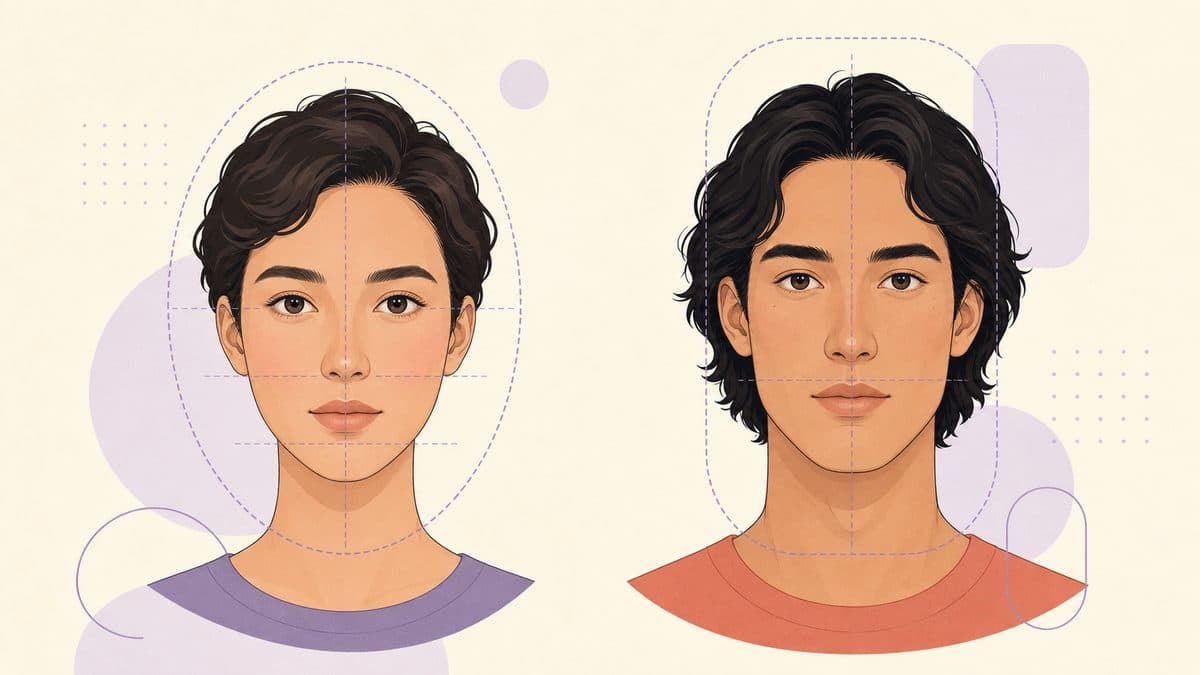
The ratio is a relationship, not a cutoff
No universal decimal separates the categories. Look for whether length merely exceeds width or clearly dominates it, then confirm with the side outline. Camera distance and cropping make exact ratios unreliable across unrelated photos.
Feature comparison
| Observation | Oval | Oblong |
|---|---|---|
| Length-to-width | Moderately elongated | Strongly elongated |
| Cheekbones | Create a gentle outward curve | May be widest but sides remain even |
| Side outline | Curves and tapers | Often straighter or parallel |
| Jaw | Softly narrows | May retain more width |
| Chin | Rounded | Rounded, broad, or softly square |
Try this measurement sequence
- Measure visible length and maximum width on the same straight photo.
- Ignore hairstyle height and do not guess an obscured hairline.
- Compare upper-face, cheek, and jaw widths.
- Choose oval if the cheek curve and taper are clear; choose oblong if length and even side width dominate.
Why the jaw may not help immediately
Both outlines can have a soft jaw and rounded chin. The difference often appears above the jaw: oval curves outward at the cheeks and back in, while oblong can maintain a similar width for more of its height.
Hairstyles can disguise the boundary
A tall style with close sides makes an oval outline appear longer. A fringe and wide side volume make an oblong outline appear shorter. Pull hair away for identification, then use those same effects deliberately when styling.
When both descriptions fit
An oval-oblong mix is especially common because the categories sit next to each other along a length continuum. Treat the primary result as the closest summary and use the secondary result to refine hair volume or lens depth choices.
Review the complete oval and oblong guides, then use the hairstyle hub to choose an effect feature by feature. You can also analyze a consistent photo in your browser.
Frequently asked questions
Is oblong simply a long oval?
They overlap, but oblong generally adds straighter sides and a stronger length-to-width difference rather than only extra length.
Can a square jaw occur on an oblong face?
Yes. That may also be described as rectangular, but this site's seven-category system keeps it under oblong with square characteristics.
Should I measure from the hairline?
Only if it is clearly visible and you use it consistently. Otherwise use a stable visible upper-face reference and describe the measurement honestly.