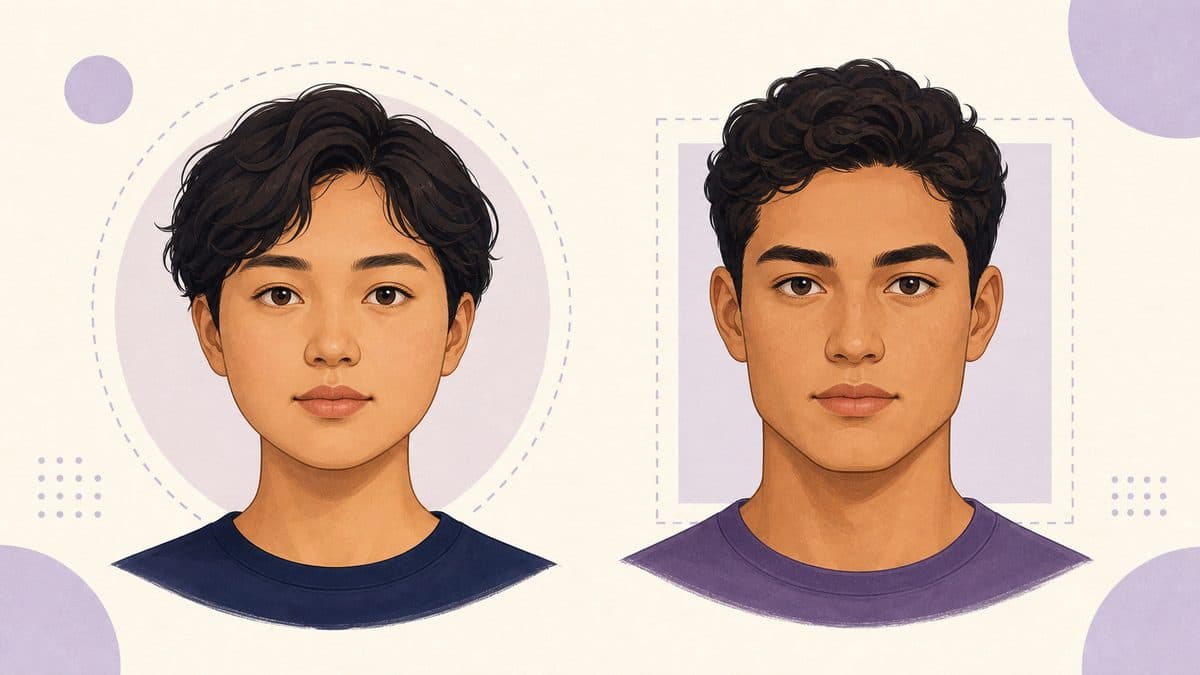
Side-by-side comparison
| Observation | Round face | Square face |
|---|---|---|
| Face length and width | Relatively close | Relatively close |
| Side outline | Continuous curve | Straighter through the sides |
| Jawline | Soft with no strong corner | Broad with a visible change of direction |
| Chin | Rounded and blended into the jaw | Broad, flat, or softly squared |
| Cheeks | Often create the fullest area | May be broad but do not erase jaw width |
| Overall impression | Circular or softly compact | Geometric or evenly wide |
Compare length with maximum width first
Both shapes usually look more compact than oval or oblong because vertical length does not dominate maximum width. Do not expect the two measurements to be identical. The useful observation is whether the face appears only slightly longer than its widest span.
If length is clearly greater, consider oval or oblong before choosing between these two. The seven face-shape overview helps place the comparison in context.
The jawline is the strongest clue
Trace from below the ears toward the chin. A round jaw follows a smooth arc with no obvious corner. A square jaw holds more horizontal width and changes direction more clearly at the lower corners. The corner can be softened by facial fullness, but its structure may still be visible in even light.
The round face guide shows how a curved jaw fits the full outline, while the square face guide explains the relationship between jaw width and upper-face width.
Use chin shape as supporting evidence
A round chin blends into the jaw without a flat central section. A square chin tends to retain width and may look flatter across the bottom. Real chins rarely match a simple geometric icon, so look for the direction of the entire lower third rather than one small edge.
Why cheeks can hide the distinction
Full-looking cheeks can soften a square outline, particularly in a smiling photo. On a round face, cheek width often continues the overall curve. On a square face, the lower jaw still tends to carry substantial width when the expression relaxes.
Soft tissue can change the visible outline without replacing the underlying pattern. This is one reason face-shape labels remain approximate rather than exact biological categories.
A three-step identification method
1. Prepare one reliable view
Use a straight, eye-level photo in soft front light. Keep hair, hands, and heavy shadows away from the jaw.
2. Compare the main proportions
Confirm that length and width are relatively close. If not, widen the comparison to oval or oblong.
3. Trace the lower outline
Choose round when the sides and jaw flow through a curve. Choose square when the jaw stays broad and the corners remain visible.
Camera angles can soften or exaggerate the jaw
A camera held above eye level can make the chin smaller and hide jaw width. A low camera can emphasize the jaw and underside of the chin. Close wide-angle selfies also change the balance between the centre and outer edges of the face.
Keep the phone farther away, at eye level, and parallel to the face. The photo consistency guide explains why two uncontrolled images can produce different results.
When the result is mixed
A round-square mix may have compact proportions and full cheeks with jaw corners that remain noticeable. Use square guidance when thinking about the lower face and round guidance when thinking about the cheek curve. A mixed result is descriptive, not contradictory.
Try the private detector with a controlled photo, then verify its explanation using the manual measurement guide.
Frequently asked questions
Can a square face have soft cheeks?
Yes. Cheek fullness can soften the outline, while a broad jaw and visible lower corners still support a square pattern.
Can a round face have a defined jawline?
It can have definition, especially with directional light, but its outline usually remains curved rather than holding broad width through distinct corners.
Does facial hair change the answer?
Facial hair can change the visible silhouette and hide jaw corners. Check the natural edge where possible and treat any hidden area as uncertain.
What if my face is longer than both examples?
Compare oval and oblong shapes. Length is a primary proportion, so it should be checked before choosing based only on jaw shape.